When Your Body Needs More Care is a free practical guide for life with hEDS, HSD, or a related connective tissue disorder — whether you have a diagnosis or are still searching for one.
EDS Connective
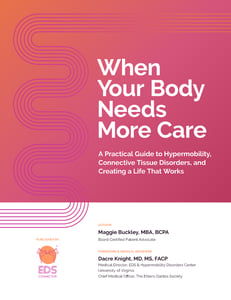
When Your Body Needs More Care
A Practical Guide to Hypermobility, Connective Tissue Disorders, and Creating a Life That Works
Delivered instantly to your inbox.
— Maggie Buckley, MBA, BCPA, Author
Grounded in five core pillars of health—movement, hydration & nutrition, sleep, mental health, and surroundings—and built from lived experience, clinical collaboration, and patient advocacy, this guide was created to help everyone in this community navigate life with hEDS, HSD, or a related connective tissue disorder — whether you have a diagnosis or are still searching for one.
Read sample excerpts from Part I below.
Finding Your Footing
Sample from the Introduction
You may feel as though this journey began the day someone finally named what was happening in your body, but in truth, you have already been at sea for a very long time. Long before there was a diagnosis, there was the work of staying afloat: noticing changes, adapting quietly, and learning what your body could and could not tolerate. A diagnosis can feel clarifying, but it does not hand you a complete map. It simply gives you a better starting point for understanding the body you are in and the care it may need. Throughout this book, I return to a simple image: the boat you are already in. What matters is not building the biggest boat or gathering the largest crew. It is steadying what you have, learning the waters you are in, thoughtfully adding support, and recognizing the care partners who are already alongside you. This book begins there—in the middle of the voyage, where you already are, learning how to steady the boat you have.
Get all 14 chapters free →Calm Is the First Step Forward
Sample from Chapter 01
When fear first rises, it can feel as though the only sensible response is speed—more research, more appointments, more solutions, more effort. But a body already under strain rarely settles through force. Before you add more tasks, more information, or more urgency, it helps to begin by quieting the system enough to see what is actually happening. Calm is not passivity, denial, or weakness. It is the first practical step in building steadiness, because it helps you notice what is already supporting you and what needs attention first. Before you chart a new course, you steady the boat you are already in.
Get all 14 chapters free →What This Diagnosis Means for You
Sample from Chapter 02
A diagnosis does not tell you everything, but it can begin to explain what kind of body you are living in. It can help make sense of why the same demands may feel different for you than they do for someone else, and why your body may need more support, more recovery, or a different way of moving through the world. Learning about connective tissue is not only about anatomy. It is also about recognition: understanding the structure you are working with, where it is resilient, and where it may need more protection. In that way, diagnosis is less a destination than the first clear look at the boat you are learning to navigate—and the waters it has already been carrying you through.
Get all 14 chapters free →After Diagnosis: Relief, Grief, and What Comes Next
Sample from Chapter 03
For many people, diagnosis brings relief first: a name, an explanation, a sense that the confusion may finally start to lift. But that relief is often followed by something more complicated. A diagnosis may answer an important question, while also introducing grief, uncertainty, and the realization that care may still be difficult to access and coordinate. Knowing what is happening does not end the work. It changes the work. You are no longer drifting without a name, but you are still learning how to travel these waters with more clarity and steadiness.
Get all 14 chapters free →Building a System That Supports You
Sample from Chapter 04
A good system becomes most valuable on the days when your energy is low, your symptoms are louder, or your words are harder to find. Preparation is not overthinking. It is a practical form of self-support. When appointments, records, medications, symptoms, and decisions start to pile up, even a few organized tools can reduce stress and help you communicate more clearly. This chapter is about building that kind of structure—not perfection, but enough order to make the next step easier. A well-packed boat handles rough water with less panic.
Get all 14 chapters free →Making Decisions When Things Are Hard
Sample from Chapter 05
Not every symptom, recommendation, or decision carries the same weight. Some situations are urgent, some are important, and some can safely wait until you have more information and more steadiness. When you live with a chronic condition, decision-making is rarely simple, and pressure can make everything feel equally immediate. This chapter is about learning how to sort urgency from noise, ask better questions, and make choices that are safer, more sustainable, and more aligned with the life you are actually living. Good navigation is not only about moving forward; it is about knowing when to hold your course, when to anchor, and when to wait for clearer weather.
Get all 14 chapters free →What Integrative Care Looks Like in Real Life
Sample from Chapter 06
When symptoms involve more than one body system, care often works best when multiple kinds of expertise are involved. Integrative care is not about collecting the largest possible team. It is about building a workable support structure where different people and strategies can contribute without pulling in opposite directions. For many people with connective tissue disorders or hypermobility, that kind of care does not happen automatically. This chapter is about what integrative care means, why it matters, and how to build it even when the system around you is fragmented. What matters is not the biggest boat. It is the right crew for the waters you are in.
Get all 14 chapters free →Listening to Pain, Building Support
When Rest Does Not Restore You
Rethinking Pacing
Practical Supports for Daily Life
Accessing Disability Services and Support
Living with Joy, Humor, and Purpose
Building Supportive Connection
Respect, Reciprocity, and Mutual Support
A Patient-Friendly History of the Ehlers–Danlos Syndromes
Marfan Syndrome: An Explainer
Loeys-Dietz Syndrome: A Narrative Overview
Understanding Mast Cells and Mast Cell Activation Syndrome (MCAS)
Understanding Dysautonomia and Orthostatic Intolerance
Resources and Further Reading
Author
Advocacy Advisor & Patient Representative
Ms. Buckley has been a Health/Patient Advocate for over three decades while living with a chronic pain condition. She works with individuals, their families, and caregivers to access appropriate healthcare services to address their most pressing needs, and maintains a robust network with other Health Advocates to refer clients to specialist advocates. She currently volunteers in many roles for the Ehlers-Danlos Society, the Loeys-Dietz Syndrome Foundation Canada, and the Loeys-Dietz Foundation (a division of the Marfan Foundation USA). She has also represented the voices of lived experience on research projects covering connective tissue disorders, pain management, and other health topics.
With an undergraduate degree in Social Work and an MBA in Accounting, Maggie became a Board Certified Patient Advocate in 2019. She is active in legislative and regulatory advocacy, has testified at policy hearings, has spoken at conferences and in the media, written articles, and coached hundreds to self-advocate for better care.
This is the book I wish had existed when I was first diagnosed. What many people need most after diagnosis is not only medical information—they also need practical ways to care for themselves, communicate clearly, make decisions, and build a life that does not revolve entirely around symptoms.
Foreword & Medical Review
Medical Director, EDS & Hypermobility Disorders Center, University of Virginia · Chief Medical Officer, The Ehlers-Danlos Society
Dr. Knight is the Medical Director of the EDS & Hypermobility Disorders Center at the University of Virginia, where he also serves as an Associate Professor of Medicine. He recently joined The Ehlers-Danlos Society as Chief Medical Officer. A board-certified internal medicine physician, he specializes in consultative and diagnostic medicine with a clinical focus on chronic disease, unresolved illness, and the coordinated care of patients with Ehlers-Danlos syndromes. Before joining UVA in late 2025, Dr. Knight founded and led the Mayo Clinic EDS Clinic for over six years, during which he was instrumental in securing the facility's recognition as an EDS Center of Excellence.
"This is foundational reading for those wishing to live better with hypermobility."
— Beth Darnall, PhD · Professor, Anesthesiology, Perioperative and Pain Medicine · Director, Stanford Pain Relief Innovations Lab · Stanford University School of Medicine
Contributing Experts
The following clinicians and patient advocates contributed their expertise and insights throughout the guide.
Lara Bloom
President & CEO, The Ehlers-Danlos Society · Academic Affiliate Professor of Practice in Patient Engagement and Global Collaboration, Penn State College of Medicine
"Many face years—sometimes decades—without a diagnosis, navigating a system that overlooks or misunderstands their symptoms. Even with a diagnosis, access to knowledgeable healthcare professionals and coordinated multidisciplinary care remains limited in most parts of the world."
Dr. Linda Bluestein
MD · Board-Certified Anesthesiologist & Integrative Pain Medicine Physician
"Everything in the body is connected, but medicine is often taught and practiced in separate systems. In reality, sleep affects pain, pain affects the nervous system, the nervous system affects digestion, and digestion affects energy and nutrient status."
Dr. Sarah Cohen Solomon
MD, FAAP · Pediatrician · Assistant Professor of Pediatrics, University of Virginia School of Medicine
"The difference between body awareness and fixation is often a fine line. Decision trees can be helpful here; start with simple questions with simple solutions. 'I feel yucky. Am I thirsty? Have a drink. Am I hungry? Have a snack. Am I tired? Take a short rest.' The goal is to be able to identify urgency without your life being ruled by body scans, symptom checks, and wellness apps. I want my patients living with chronic illness, not constantly fighting it."
Jeannie Di Bon
MSc, MA · Movement Educator & Hypermobility Specialist · Founder, The Zebra Club & Integral Movement Method
"The brain and nervous system love visualization. We can create sensations through imagined or emotionally associated experiences. In persistent pain states, the nervous system can become highly protective and sensitized. Gentle visualization can help shift the body from a state of threat toward one of safety and regulation."
Dr. Irman Forghani
MD, FACMG · Director of Clinical Genetics and Genomics · Mount Sinai Medical Center
"Diagnosing a connective tissue disorder is like assembling a puzzle—no single feature tells the whole story. It requires integrating a detailed personal and family history, careful physical examination, and often, genetic testing to identify the underlying cause. A comprehensive evaluation is essential because many of these conditions share overlapping, multisystem, and nonspecific features. A complete workup, including genetic testing, helps to confirm a diagnosis and distinguish between look-alike conditions with different risks and management implications.
"Genetic testing plays a central role, particularly when the presentation suggests a recognizable syndrome. But the goal is not simply to assign a label—it is to guide surveillance, inform treatment decisions, clarify recurrence risk, and help patients and families better understand the road ahead."
Dr. Alan Hakim
MD, MA, FRCP(UK) · Medicine & Rheumatology · Hypermobility-Related Disorders · Principal Investigator Registry & Biobank, The Ehlers-Danlos Society
"If you ask a general doctor on the street what EDS is, you're more likely to get 'I don't know.' But if they do know, they'll probably say it's something about joints and something about skin. Well, it's an awful lot more than that—ocular, dental, neurological, gastrointestinal, pulmonary, cardiovascular, musculoskeletal, bladder. Every single system is involved."
Shailavi Jain
RPh, BCPA · Registered Pharmacist & Board-Certified Patient Advocate
"An organized patient is an empowered patient. Gathering your health story is often the first step toward advocating for yourself."
Caroline Kim
BCPA, MSJ · Founder, Norbella Health Advocates
"Hiring a professional patient advocate isn't a sign of defeat; it's a strategic choice to clear the hurdles in your way. Whether you need an expert to manage the heavy lifting of a medical records request, a guide to decode complex treatment options, or a bridge to the right care providers, an advocate is a powerful ally. They ensure your voice is heard today, while building the foundation you need to confidently stand up for your own health tomorrow."
Dr. Melissa Koehl
Physical Therapist
"As a DPT living with hEDS, I've learned that nervous system regulation is essential for managing fatigue, pain, dysautonomia, GI symptoms, and mast cell issues. Meditation can be helpful for many people, but for me, it often worsens fatigue. For many of my patients and clients, especially those with autism or ADHD, the act of sitting quietly can actually feel more dysregulating or anxiety-producing. Instead, things like gentle movement, vagus nerve stimulation through vocalizing or humming, and short breathing exercises (even just one slow exhale) can be much more effective and efficient ways to help the nervous system feel safe and regulated."
Erin Kolb
MSN, FNP-C · Allergy & Immunology · Mast Cell Disease Specialist
"I often tell patients that each positive change, even if it seems small, can add up to make a meaningful difference. Whether it comes from improving fluid volume, supporting good nutrition, finding a helpful medication, understanding triggers, or making other healthy adjustments, every piece matters. It is also important to remember that skipping meals or avoiding food in an effort to prevent or control symptoms can unintentionally worsen symptoms over time."
Dr. Denielle C. Medynski
DMD, Diplomate, American Board of Orofacial Pain
"Any oral hygiene technique that can reduce loading of the joints and stressing of the ligaments would be beneficial. This includes both the jaw and hand joints and any associated ligaments. Brushing and flossing can be strenuous on these joints."
Jesse Miller
MS, OTR/L · Occupational Therapist & Craniosacral Therapist · Founder, Conscious Connections OT
"Craniosacral therapy can be really helpful for patients with hypermobility and connective tissue disorders. The steady power of light touch can help to create an environment of safety within the body. When our bodies feel safe, they are more open to feeling supported—and when our bodies feel supported, our nervous system can move towards regulation."
Dr. Jessica Pizano
DCN, CNS · Clinical Nutritionist & Exercise Specialist
"The world of nutrition can be complex to navigate, particularly when you are dealing with health issues. Avoid health advice you find online, in social media, or on television. At the end of the day, the foundation of nutrition should be eating the widest range of foods your body tolerates. This will look different for each of us, but any diet that limits you unnecessarily is harmful."
Dr. Alan Pocinki
MD · General Internist
"Poor sleep is often part of a vicious cycle of chronic pain, poor sleep, depression, and fatigue, and each of these must be addressed concurrently in order to break the cycle and improve them all."
Bridget Porter (Metz)
Loeys-Dietz Syndrome Advocate
"In the wake of losing our 13-year-old son, Connor, due to an aortic dissection resulting from undiagnosed Loeys-Dietz syndrome, we quickly realized the importance of knowledge and community. Because Loeys-Dietz syndrome is rare, it is often misdiagnosed or undiagnosed and shares many common traits with hypermobile Ehlers-Danlos syndrome (hEDS). This is why community building across HSD, EDS, and vascular connective tissue disorder groups is more than just support—it is a critical survival mechanism."
Dr. Chad Shepherd
Clinical Psychologist
"In order to heal, the body needs safety. Safety comes in many forms—a good night's sleep, rest, and connection with our values. In our modern lives, there are always ongoing challenges, particularly with chronic health problems. A good place to start is by calming the nervous system."
Sabrina Vaz
Second-Generation Pilates Instructor & Certified Somatic Practitioner
"When someone has a hypermobility disorder such as Ehlers-Danlos syndrome, movement is medicine. But the prescription has to be individualized—one built around training the deep muscles to support loose joints, calming the nervous system, and developing awareness of where the body is in space. And like any prescription, it is about consistency."
Published by EDS Connective — an online platform connecting adults with independently licensed providers who specialize in hEDS and HSD diagnostic evaluation, in all 50 states, no referral needed. Learn more →
Receiving a diagnosis of hypermobile Ehlers-Danlos Syndrome (hEDS) or Hypermobility Spectrum Disorder (HSD) is only the beginning. For most patients, the hardest part comes next — navigating a healthcare system that has no standard protocol for what happens after you leave that appointment. The confusion, the grief, the fragmented care, the exhaustion of explaining yourself again and again: these are not signs that something is wrong with you. They are signs that you need a better map.
When Your Body Needs More Care: A Practical Guide to Hypermobility, Connective Tissue Disorders, and Creating a Life That Works was written by Maggie Buckley, MBA, BCPA — a Board-Certified Patient Advocate with over three decades of lived experience navigating connective tissue disorders — and published by EDS Connective. The guide covers the practical, emotional, and clinical ground that your diagnosis appointment rarely has time to address. It is free for everyone in this community, whether you have a diagnosis or are still searching for one.
Topics covered include: understanding heritable connective tissue disorders and co-occurring conditions such as dysautonomia, POTS, and mast cell activation syndrome (MCAS); nervous system regulation and managing chronic fight-or-flight; organizing medical records and preparing for specialist appointments; pacing strategies built specifically for hypermobile bodies; integrative care beyond the clinical setting including movement, nutrition, hydration, sleep, and mental health; accessing disability services and support; and building a life with joy, purpose, and community after diagnosis.
The guide is medically reviewed by Dr. Dacre Knight, MD, MS, FACP — Medical Director of the EDS & Hypermobility Disorders Center at the University of Virginia, Chief Medical Officer of The Ehlers-Danlos Society, and former founder of the Mayo Clinic EDS Clinic — and informed by the expertise of 17 contributing clinicians and patient advocates specializing in pain medicine, physical therapy, orofacial pain, clinical nutrition, autonomic and sleep disorders, clinical psychology, occupational therapy, patient advocacy, mast cell disease, somatic movement, pediatrics, and rheumatology.
This guide is intended for patients recently diagnosed with hEDS or HSD, care partners supporting someone with a connective tissue disorder, and healthcare professionals seeking a clearer picture of what daily life asks of their patients.
When Your Body Needs More Care: A Practical Guide to Hypermobility, Connective Tissue Disorders, and Creating a Life That Works
Written by Maggie Buckley, MBA, BCPA · Published by EDS Connective · edsconnective.com
ISBN: 979-8-9963001-0-5 · © 2026 EDS Connective. All rights reserved. · First published June 2026
No part of this publication may be reproduced, distributed, or transmitted in any form or by any means without the prior written permission of the publisher.
Download Disclaimer
When Your Body Needs More Care is a free educational resource published by EDS Connective. The content is for informational purposes only and does not constitute medical advice. EDS Connective is not a healthcare provider. By downloading this guide, you acknowledge that the information provided is educational in nature and is not a substitute for professional medical care.
Disclosure
This guide was authored by Maggie Buckley, MBA, BCPA, and medically reviewed by Dr. Dacre Knight, MD, MS, FACP; both serve as advisors to EDS Connective and may receive compensation or travel reimbursement. Additional contributions were provided by EDS Connective advisors Dr. Alan Hakim and Jeannie Di Bon. In addition to her advisory role, Jeannie Di Bon maintains a business relationship with EDS Connective via The Zebra Club. Dr. Melissa Koehl maintains a business relationship with EDS Connective via Chimera Health. These financial and business relationships are disclosed in accordance with the FTC Endorsement Guides. The views expressed are those of the individual contributors and do not necessarily reflect the official positions of EDS Connective.
Important - Please Read Before Continuing
This publication is for informational and educational purposes only. The content in When Your Body Needs More Care: A Practical Guide to Hypermobility, Connective Tissue Disorders, and Creating a Life That Works is intended to provide general health education and awareness. It is not intended as, and shall not be construed as, medical advice, diagnosis, treatment, or a substitute for professional medical care.
About the author. This guide was written by Maggie Buckley, MBA, BCPA, a board-certified patient advocate. Ms. Buckley is not a licensed healthcare provider. The content reflects her professional experience in patient advocacy and health education, not clinical guidance.
About the contributing providers and medical reviewer. This guide contains contributions from physicians and healthcare providers and has been reviewed for medical accuracy by Dacre Knight, MD, MS, FACP. All provider contributions and Dr. Knight’s review are limited to general educational content. They do not constitute individualized medical advice, do not create a provider-patient relationship with any reader, and do not constitute an endorsement of EDS Connective, its platform, or its commercial services. Any personal experiences, observations, opinions, or perspectives shared by contributors reflect their individual professional and/or lived experiences and should not be interpreted as guarantees of any particular health outcome.
About the publisher. This guide is published by EDS Connective, LLC, a virtual health platform facilitating access to online hEDS and HSD diagnostic evaluation by independent physicians in all 50 states. EDS Connective is not a healthcare provider and does not render medical diagnoses, provide treatment, or practice medicine.
No guaranteed outcomes. No representation is made that following any suggestion, recommendation, or information in this guide will produce any particular health outcome, improvement, or result. Every individual's health circumstances are unique. What is informative for one reader may not be appropriate for another.
Consult your healthcare provider. Always seek the advice of your physician or other qualified healthcare provider before making changes to your healthcare, treatment plan, physical activity, diet, or medications. Never disregard professional medical advice or delay seeking it because of information you have read in this publication.
If you are experiencing a medical emergency, call 911 or your local emergency services immediately.