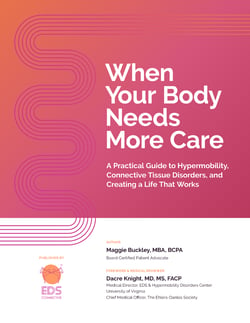



eBook Author
Maggie Buckley, MBA, BCPA
Medically Reviewed by
Dr. Dacre Knight, MD, MS, FACPNovember 2026 · 4 min read
Adapted from Chapter 4 of When Your Body Needs More Care: A Practical Guide to Hypermobility, Connective Tissue Disorders, and Creating a Life That Works by Maggie Buckley, MBA, BCPA. Published by EDS Connective. Download the full eBook free →
Organizing records, preparing for appointments, and tracking symptoms can feel like a lot, especially on low-energy days. This post, adapted from the end of Chapter 4 of When Your Body Needs More Care, is about where support can come from and how to find the right patient advocate. For the full system, start with Building a System That Supports You.
You Do Not Have to Do This Alone
If building a system for your care feels like a lot, please know this: you are not alone, and you are not expected to carry all of this by yourself. It is okay if the process feels like a lot. Building systems for your care is something you can do slowly, gently, and with support. You do not have to do everything at once, and you do not have to do it perfectly for it to help. Support can come from a trusted friend, family member, care partner, or a professional advocate who can stand beside you as you organize records, prepare for appointments, track symptoms, and communicate with your care team.
The best advocates do not start only with your diagnosis or what is written in your chart. They start with your full story. That includes your living situation, what matters most to you, your goals, your day-to-day responsibilities, and the resources you have available. When someone understands that bigger picture, they can help you formulate better questions, connect symptoms across multiple systems, and think through next steps that actually fit your life.
If you need more structured guidance, a Board Certified Patient Advocate (BCPA) can help with everything described in Building a System That Supports You—and often more. A BCPA can help you organize records, prepare for appointments, track symptoms, clarify your concerns, identify support services, explore accommodations at work or school, and connect with community resources that fit your needs and circumstances. In other words, they can help you build the kind of support system that post describes and strengthen it in ways that make moving forward feel more possible.
Caroline Kim, BCPA, MSJ
"Hiring a professional patient advocate isn't a sign of defeat; it's a strategic choice to clear the hurdles in your way. Whether you need an expert to manage the heavy lifting of a medical records request, a guide to decode complex treatment options, or a bridge to the right care providers, an advocate is a powerful ally. They ensure your voice is heard today, while building the foundation you need to confidently stand up for your own health tomorrow."
Tips for Hiring the Right Patient Advocate
- Look for someone who listens before offering solutions. A good advocate should take the time to understand your story, goals, concerns, and priorities before recommending next steps.
- Find someone who sees the whole picture. EDS rarely travels alone. Look for an advocate who understands common related conditions such as POTS, MCAS, gastrointestinal issues, chronic pain, and fatigue, and who can help connect the dots across multiple providers.
- Ask about their training and scope of services. Advocacy is a broad field. Make sure you understand what services they provide, whether they have specialized training related to EDS or chronic illness, and how they can support you.
- Choose someone whose approach aligns with your values. Whether you prefer a conventional, holistic, or blended approach to healthcare, your advocate should respect your preferences and support informed decision-making.
- Consider whether lived experience matters to you. While not required, personal experience with chronic illness or caregiving can bring a level of empathy, patience, and practical understanding that is difficult to teach.
- Pay attention to how you feel after speaking with them. The right advocate should help you feel less overwhelmed, more informed, and better prepared to move forward.
— Shailavi Jain, RPh, BCPA
Keep reading: Building a System That Supports You: Appointment Prep for hEDS and HSD →
Still looking for answers? See how an evaluation works, browse the FAQ, or meet our independent providers.
Maggie Buckley, MBA, BCPA
Advocacy Advisor & Patient Representative
Author · When Your Body Needs More Care
Maggie Buckley has been a health and patient advocate for over three decades while living with a chronic pain condition. A Board Certified Patient Advocate (BCPA) since 2019, she volunteers with the Ehlers-Danlos Society, the Loeys-Dietz Syndrome Foundation Canada, and the Loeys-Dietz Foundation. She has represented lived experience on research projects covering connective tissue disorders and pain management, testified at policy hearings, spoken at conferences, and coached hundreds of patients to self-advocate for better care. She is the author of When Your Body Needs More Care, published by EDS Connective in 2026.
View full bio →
Dr. Dacre Knight, MD, MS, FACP
Medical Director, EDS & Hypermobility Disorders Center · University of Virginia
Chief Medical Officer · The Ehlers-Danlos Society
Dr. Knight is the Medical Director of the EDS & Hypermobility Disorders Center at the University of Virginia, where he also serves as Associate Professor of Medicine and Chief Medical Officer of The Ehlers-Danlos Society. A board-certified internal medicine physician specializing in consultative and diagnostic medicine, he founded and led the Mayo Clinic EDS Clinic for over six years. He provided the foreword and medical review for When Your Body Needs More Care.
View full bio →Important — Please Read
This publication is for informational and educational purposes only. The content in When Your Body Needs More Care is intended to provide general health education and awareness. It is not intended as, and shall not be construed as, medical advice, diagnosis, treatment, or a substitute for professional medical care.
About the author.
This guide was written by Maggie Buckley, MBA, BCPA, a board-certified patient advocate. Ms. Buckley is not a licensed healthcare provider. The content reflects her professional experience in patient advocacy and health education, not clinical guidance.
About the contributing providers and medical reviewer.
This guide contains contributions from physicians and healthcare providers and has been reviewed for medical accuracy by Dacre Knight, MD, MS, FACP. All provider contributions and Dr. Knight's review are limited to general educational content. They do not constitute individualized medical advice, do not create a provider-patient relationship with any reader, and do not constitute an endorsement of EDS Connective, its platform, or its commercial services. Any personal experiences, observations, opinions, or perspectives shared by contributors reflect their individual professional and/or lived experiences and should not be interpreted as guarantees of any particular health outcome.
About the publisher.
This guide is published by EDS Connective, LLC, a virtual health platform facilitating access to online hEDS and HSD diagnostic evaluation by independent physicians in all 50 states. EDS Connective is not a healthcare provider and does not render medical diagnoses, provide treatment, or practice medicine.
No guaranteed outcomes.
No representation is made that following any suggestion, recommendation, or information in this guide will produce any particular health outcome, improvement, or result. Every individual's health circumstances are unique. What is informative for one reader may not be appropriate for another.
Consult your healthcare provider.
Always seek the advice of your physician or other qualified healthcare provider before making changes to your healthcare, treatment plan, physical activity, diet, or medications. Never disregard professional medical advice or delay seeking it because of information you have read in this publication.
If you are experiencing a medical emergency, call 911 or your local emergency services immediately.
Disclosure: This blog was adapted from the eBook authored by Maggie Buckley, MBA, BCPA, and medically reviewed by Dr. Dacre Knight, MD, MS, FACP; both serve as advisors to EDS Connective and may receive compensation or travel reimbursement. Additional contributions were provided by patient advocates Shailavi Jain, RPh, BCPA, and Caroline Kim, BCPA, MSJ. The views expressed are those of the individual contributors and do not necessarily reflect the official positions of EDS Connective.